|
THIRD COLOMBIAN FILM INDUSTRY BULLETIN
A project designed by Proimágenes using methodology of Fedesarrollo.
Download full report in Excel
Download printable version of Full Report
1. Evolution of Colombian Film Market
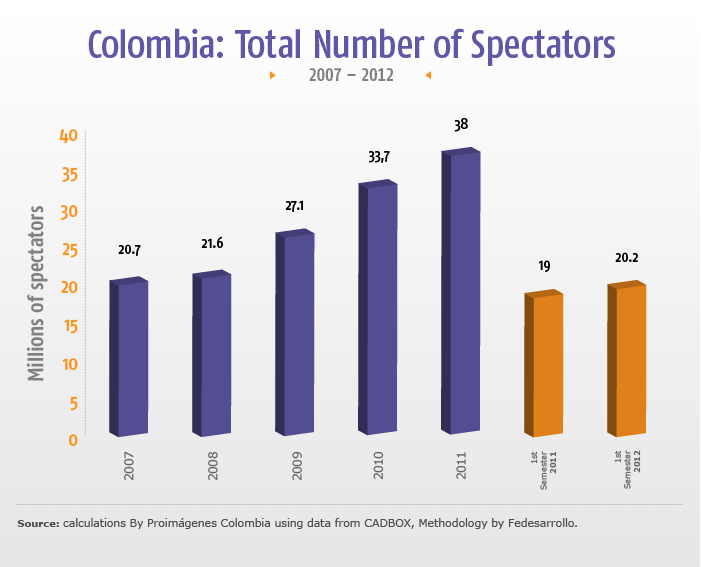
- During the first semester of 2012 the number of spectators was up by $1,189 937 over the same period in 2011.
- This represents a 6.2% increase over the same period the previous year.
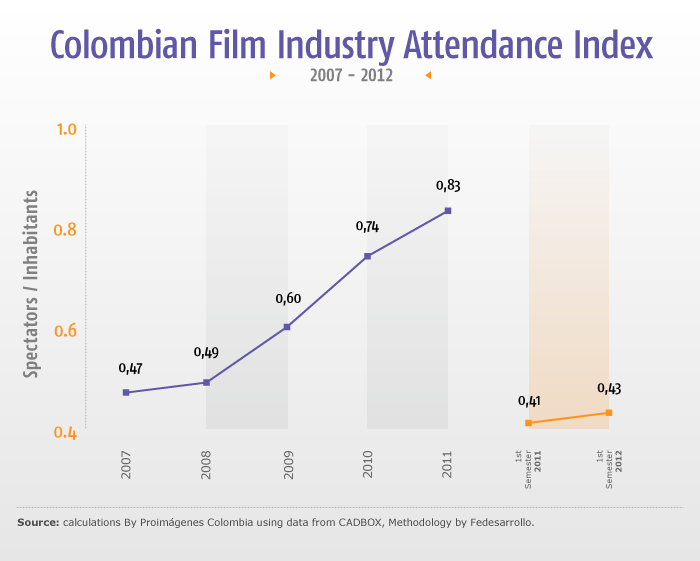
- The attendance index (spectators/inhabitants) during the first semester of 2012 grew by 5% compared to the same period in 2011.
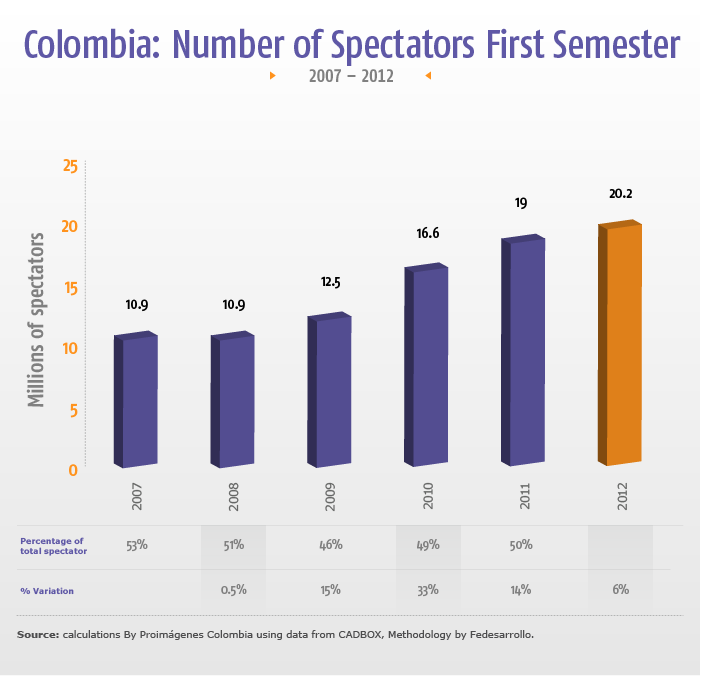
- From 2007 to 2011 the number of spectators during the first semester of each year accounted for an average 50% of total annual spectators.
- The number of spectators during the first semester of 2012 was up 6% compared to the same period the year before.
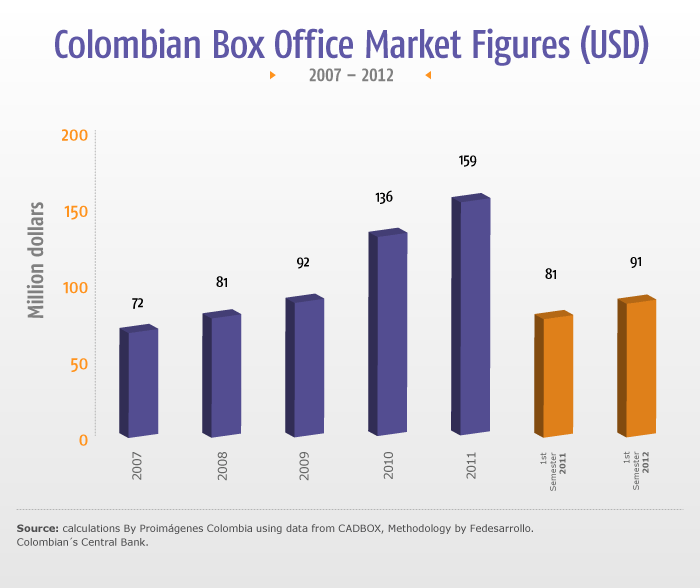
- Box office income in US dollars rose by 12% during the first semester of 2102.
- Colombian box office figures in pesos have grown by nearly 100% since 2007.
- The exchange rate used is based on the historic average for 2012 published by Colombian´s Central Bank (Banco de la República de Colombia).
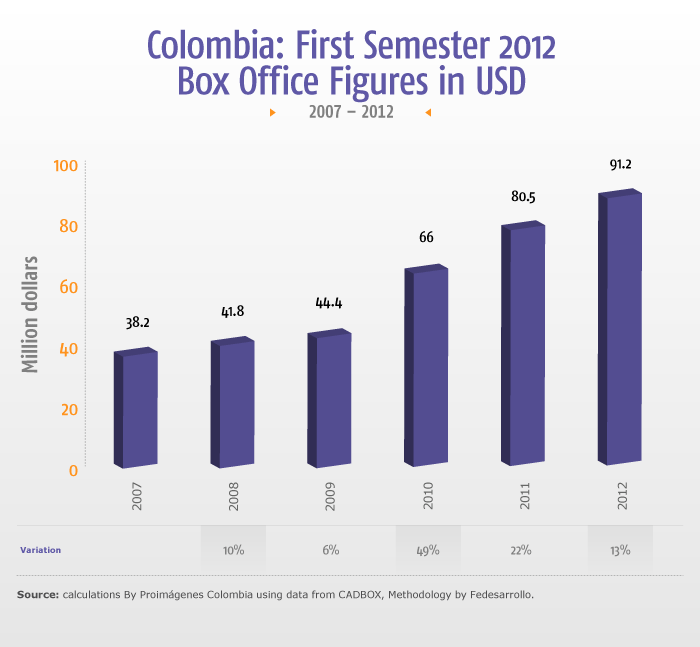
- First semester box offices figures from 2007 to 2011 have on an average accounted for 50% of yearly totals.
- Box office figures during the first semester of 2012 rose by 13% over the same period in 2011.
- The exchange rate used is based on the historic average for 2012 published by Colombian´s Central Bank (Banco de la República de Colombia).
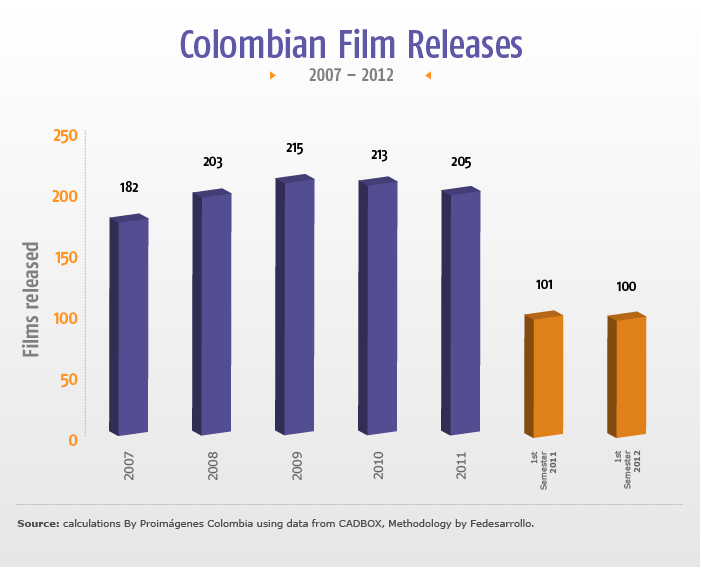
- A total of 204 films, approximately four per week, were released over the past five years.
- The number of releases has remained relatively constant since 2008, indicating that the market has stabilized with regard to the total number of yearly releases.
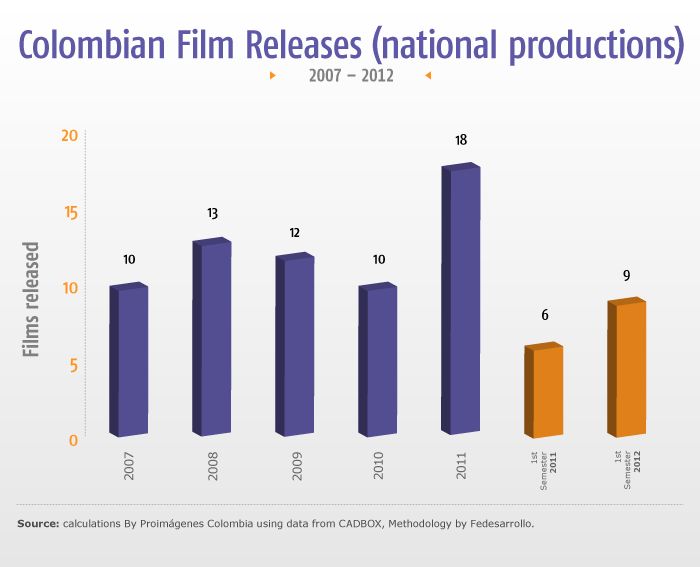
- During the first semester of 2012 a total of nine Colombian films were released, three more than during this same period the year before.
- Since Film Law 814 of 2003 and the Film Development Fund went into effect, a total of 101 Colombian films have premiered; this is the same number of films produced in Colombia between 1985 and 2002.
- A total of 250 Colombian feature films were released between 1941 and 2002.
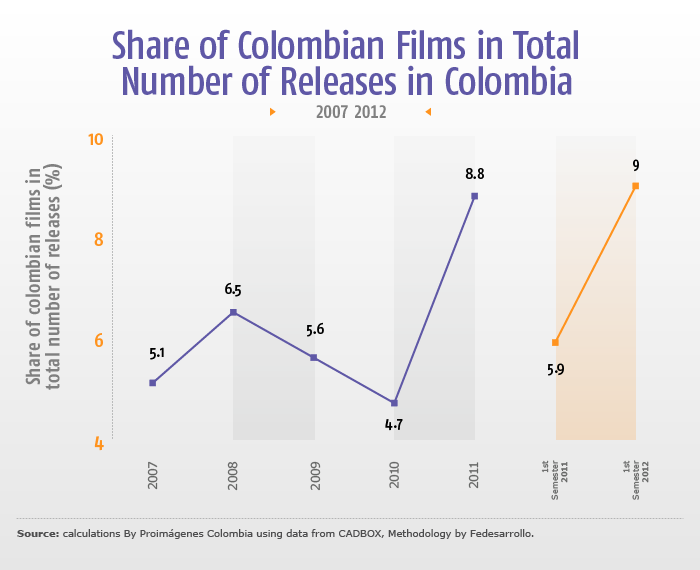
- During the first semester of 2012 the share of national films in the total number of releases reached 9%.
- So far this semester, nine Colombian films have been released, three more than during this same period in 2011.
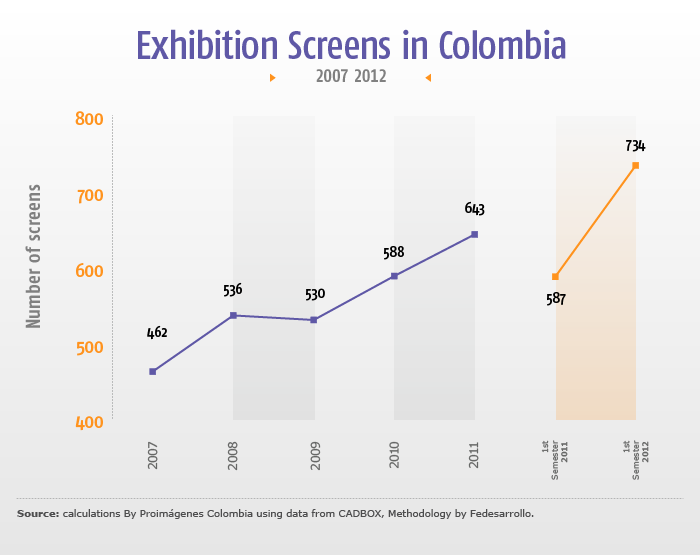
- The number of screens rose by 91 during the first semester of 2012, an increase of 14%.
- A total of 156 multi-plexes were tallied during the first semester of 2012, 17 more than at the close of 2011.
- Projection Screen: an installation comprises of a smooth surface used to project films.
- Multiplex or Film Complex: A public screening facility with more than two theaters.
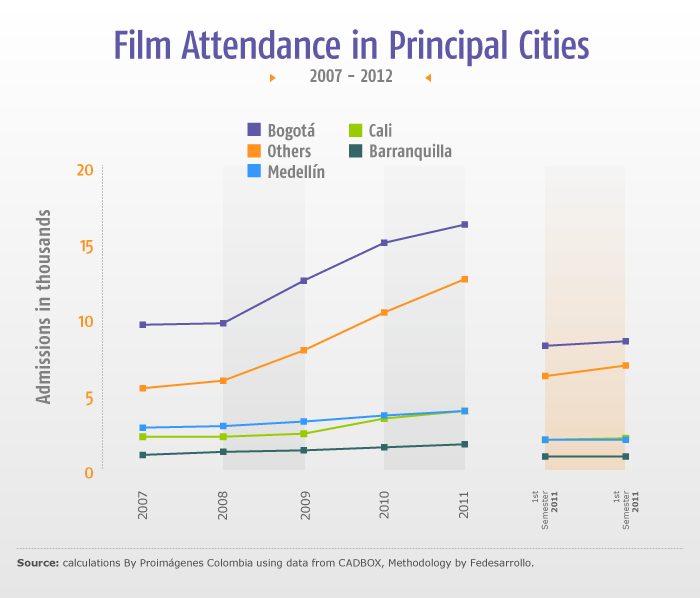
- Film attendance in Bogotá rose by 4% during the first semester of 2012, by 6% in Cali, 7% in Barranquilla , and by 12% in the rest of the country (44 cities), compared with the same period last year.
- Film attendance in Medellín dropped by 3% during the first semester of 2012 compared with the same period last year.
- Film attendance in intermediate cities has grown by 135% since 2007, which indicates a huge potential for market expansion.
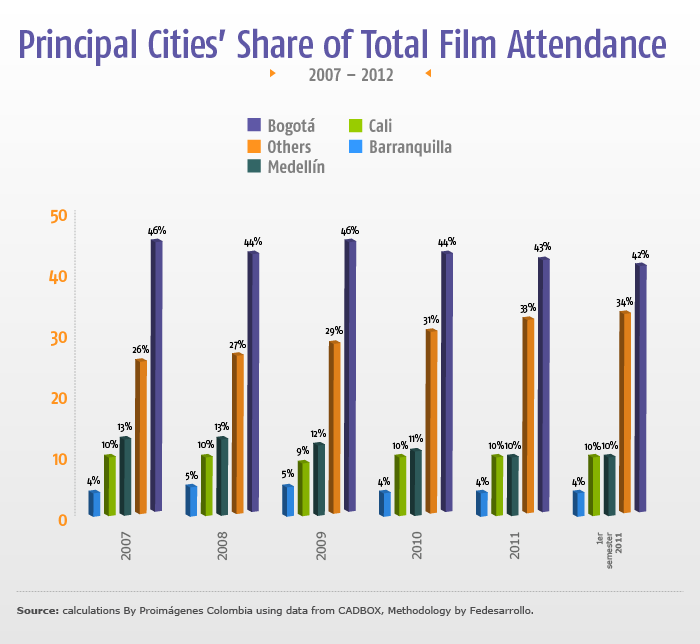
- Shares in total Colombian film attendance for the rest of the country rose by 8 percentage points between 2007 and the first semester of 2012.
- Medellín’s share has dropped by three percentage points, and Bogotá’s by four, between 2007 and 2012.
- Cali and Barranquilla have maintained constant shares..
2. Evolution of Colombian Film Industry

- Attendance at Colombian films during the semester of 2012 dropped by 25% compared with the same period in 2011.
- Phenomenal box office figures (a total of 1,500,000 spectators) for “El paseo” marked the first semester of 2011.
- Attendance during the first semester of 2012 exceeded year-end figures for 2009 and 2010.

- Historically, attendance at Colombian films is higher during the first semester of the year, since major Colombian films are released during the final months of the year and box office figures during the first months of the following year reflect this.

- During the first semester of 2012, this indicator dropped by 64% compared with the previous year.
- In absolute values, attendance at Colombian films during the first semester of 2012 was down by 25% (See Graph Attendance at Colombian Films).

- A constant trend in actual ticket prices has been noted since 2007. The average ticket price during the first semester of 2012 was $8,082 Colombian pesos, or 4.5 USD.
- Neither the advent of 3D films nor the transition to digital projection has not resulted in a rise in average actual ticket prices.

- A constant trend in actual ticket prices has been noted since 2009.

- Generally speaking, 3D animations and GP-rated films are the biggest box office successes.
- During the past five years, one Colombian film entered these ranks: «Paraiso Travel» in 2008.

- To date, “El paseo” continues to be the biggest box office success for a Colombian film.
- A record 1,120,048 spectators attended Colombian movie theaters during the last weekend in June (June 29 – July 2).
3. Growth Indicators for Colombian Film Industry

- 11 million US dollars were approved for 2012, 10% more than in 2011.
- From 2004 to 2012, the FDC approved 53 million USD in support of the Colombian film industry.

- Note the increase in the amount of resources and the number of Colombian films released – most of them recipients of FDC funding via production and national/international promotion incentives.
4. International Comparison

- A total of 38 million spectators attended films in Colombia in 2011.
- Colombia beat attendance records in Chile and came close to those for Argentina, where spectators totaled 42 million in 2011.
- Markets in Brazil and Mexico outperformed all others in Latin America with close to 100 spectators per year.


- Colombian attendance surpassed Brazil’s although Colombia has yet to reach the one-spectator-per-inhabitant mark.
- Chile broke the one-spectator-per-inhabitant barrier and Mexico and Spain are approaching the two-spectators-per-inhabitant mark.
- Generally, this is a growing trend in Latin America.
- To evaluate the information in this graph, please review relative market sizes (Graph population and GNP) and film attendance in these countries.

- Please note the total number of releases in countries like Argentina and Brazil, which exceeds 100 films.

- In 2011, the number of spectators at national films in Colombia surpassed figures for Chile and approached those for Argentina, a relevant statistic when considering that both these countries released more national films than in Colombia (24 in Chile and 125 in Argentina).

- In 2011, Colombia beat out Argentina, Mexico and Chile in spite of releasing fewer films.
- Brazil’s attendance fell by 30% in 2011. (2010 was an atypical year for national box office figures in Brazil due to the box office success of “Tropa Elite II”, which brought in a total of 10.736 million spectators).

- In 2011, this figure Colombia reached 7.8%, up 34% over 2010, and 4% during this period.
- In spite of the fewer number of national releases, the market in Colombia is stronger in this area than in Chile, Argentina and Mexico.

- The number of screens in 2011 fell only in Spain due to the fall in attendance since 2005.
- In Colombia, the number of screens from 2009 to 2012 increased by 24% to a total of 734 screens in June 2012, an increase of 91 over the end of 2011.

- In 2011, Colombia registered a 20% increase in US dollars for ticket sales as a result of revaluation. In Colombia pesos, this price remained constant.
- Colombia closed out 2011 with an average exchange rate of $1,848 COP per USD, and the average exchange through June 30, 2012 was $1,793.
- The average ticket price in Argentina in US dollars increased by 90%. Ticket prices in Argentine pesos have double in the past two years.
- Generally speaking, Latin American currency appreciated during 2011 and the trend has held throughout 2012.

- The average feature film budget in these Latin American countries was 1.3 million USD.
- Public funding for film production is directly related to the number of national releases in countries included here; in 2011, Argentina and Brazil released more than 100 national films.
5. III SPECIAL REPORT
Colombian Short Films Under Film Law 814 of 2003
INTRODUCTION
The goal of this report is to review national short film statistics from 2007 through 2011 based on official information provided by the Ministry of Culture’s Film Office, especially in light of Law 814 of 2003.
The Film Law created mechanisms to stimulate production and strengthen national and international promotion of Colombian short films that include:
Production Incentives
- Film Development Fund – FDC- incentives
- Tax incentives for those that donate and/or invest in film projects
Promotion Incentives
- Film Development Fund –FDC- incentives to projects that participate in international festivals and meetings.
- Discounts on the Film Development Quotas for the exhibitors when national short films are screened.
This sample is based on short films registered with the Ministry of Culture’s Film Office in order to obtain certification as a national product, a requirement for films seeking tax and promotion incentives and, particularly, exhibition in theaters.
A total of 167 short films were certified as national products between 2007 and 2011; 108 of them have screened in theaters and 35 have participated in international festivals and meetings. Of the 46 short films to receive FDC grants based on their technical and artistic quality, only five were certified and only one screened in theaters.
The majority of the short films produced in the country are never certified, either because they fail to comply with exhibitors’ preferences for theater release (minimum length of ten minutes; documentary in nature and suitable for all ages) or because they choose not to apply for additional incentives. Many of these films have therefore not been included in this sample.
There is a great need for mechanisms with which to measure and evaluate the true behavior and performance of short film production in Colombia and to come up with alternatives for more effective and inclusive diffusion and promotion.
The following official statistics for Colombian short films are based on those films that have received the aforementioned incentives and have screened in theaters.
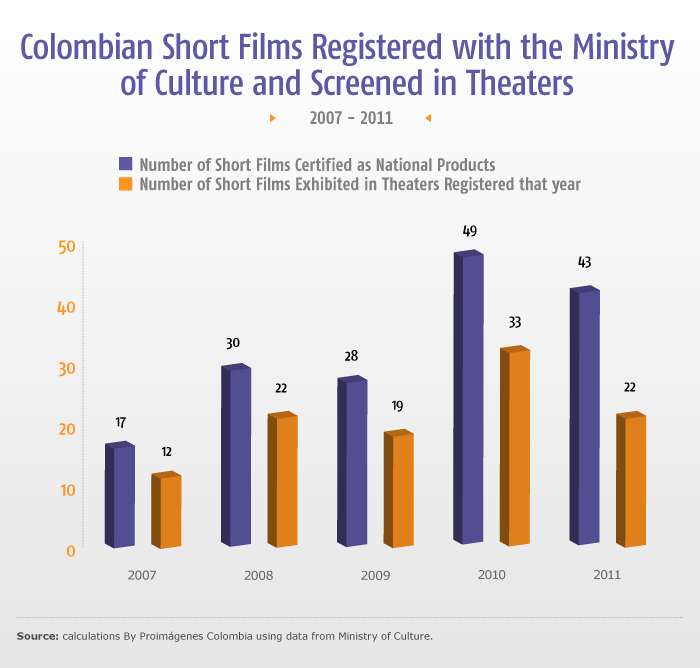
- 167 short films were registered with the Ministry of Culture’s Film Office between 2007 and 2011 to obtain certification as a national product and access investor and donor tax incentives, to apply for Film Development Fund (FDC) promotional incentives, to screen in theaters, and/or to take advantage of the Film Development Quota discount. Of these 167 films, 77% were granted audience classification status and 65% went on to screen in theaters.
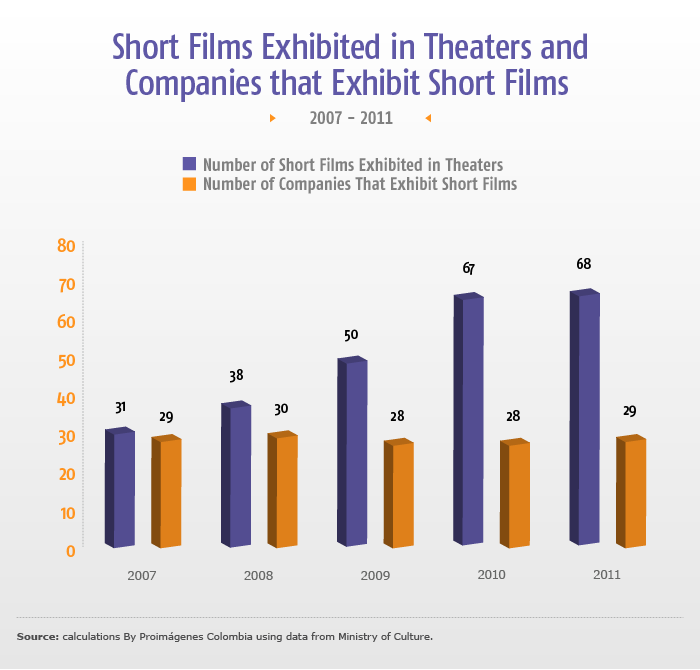
- Of the total 57 exhibitors (managing one or more theaters or exhibition spaces), 29 exhibited Colombian short films through June 2012, taking advantage of the Film Development Quota (CDC, by its Spanish acronym) discount
- Since 2007 the number of short films screened has doubled in spite of the fact that the number of exhibitors has remained the same, indicating that these exhibitors screen at least six short films yearly in order to access the CDC discount.
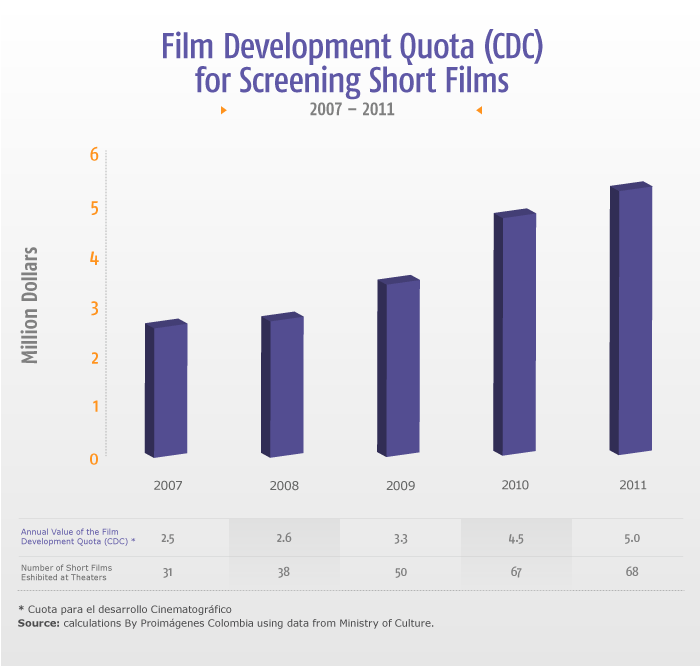
- CDC discounts for screening of short films have risen from $2.5 million USD in 2007 to $5 million USD in 2011.
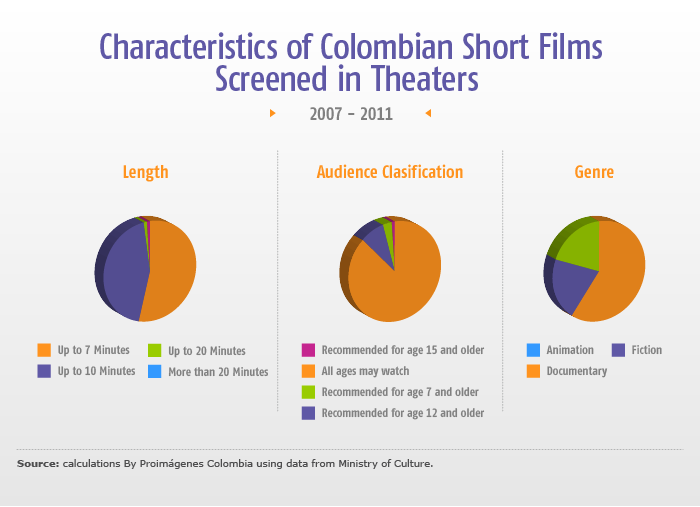
- 98% of short films screened in commercial theaters are under 10 minutes long; 88% are suitable for all ages; and 60% are documentaries.
- These are the preferred characteristics of companies that exhibit short films in order to take advantage of Film Development Quota discounts.
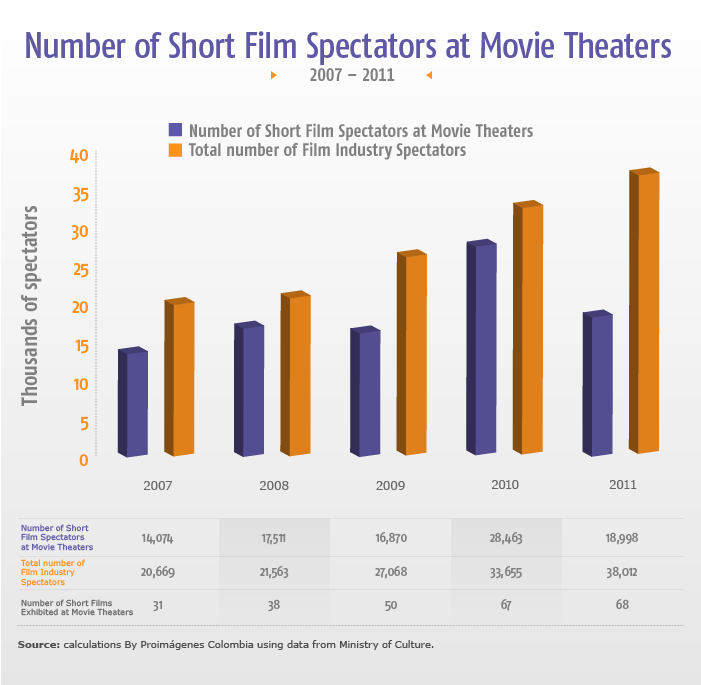
- The number of spectators at short films depends on general attendance at features exhibited in theaters on the dates when shorts are programmed.
- From 2007 to 2011, short films exhibited in theaters were seen by a total of 96 million spectators.
- 68% of total national spectators attending movie theaters between 2007 and 2011 viewed programmed short films.
- Five of the companies that exhibit short films account for 90% of the total national market; the same percentage benefits from this discount.
- The production of short films for exclusive exhibition in movie theaters generates an economic benefit for exhibitors and a potential market niche for producers.
- From 2007 to 2011, exhibition companies saved $18 million USD, compared with the $4.5 million USD spent to produce the short films exhibited in theaters during this same period.
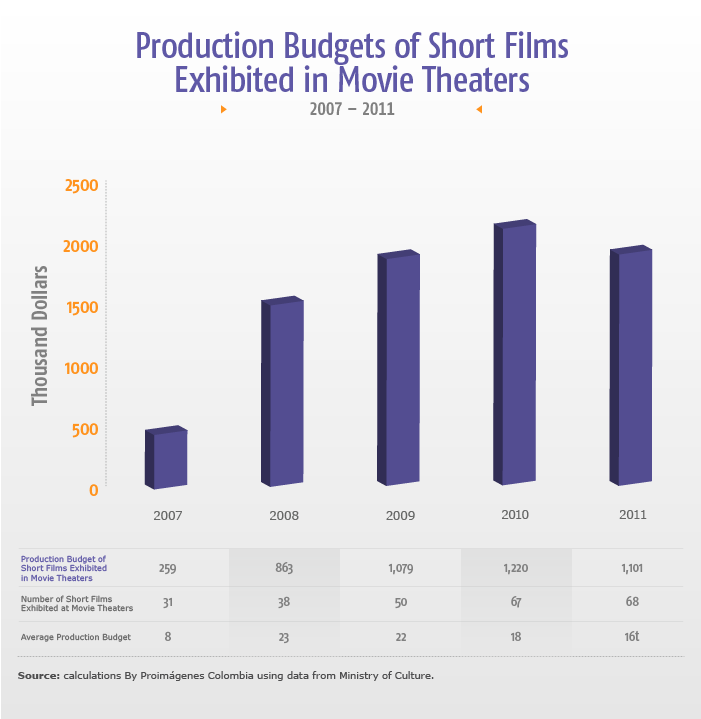
- The average production budget for a short film exhibited in theaters is $17 thousand USD.
- The average Film Development Quota discount granted companies exhibiting films was $70 thousand USD.
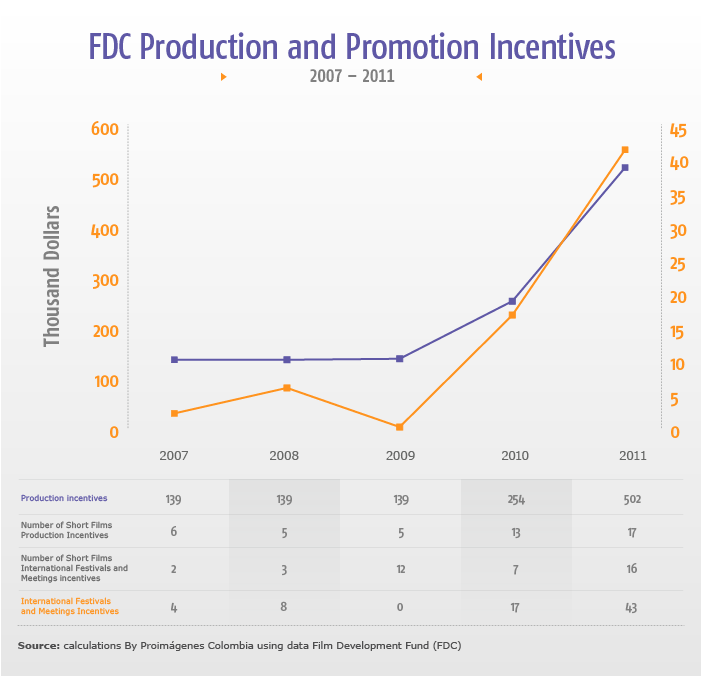
- Of all projects awarded FDC incentives during this period, five were granted national product certification in order to access festival and meeting promotion incentives; only one was exhibited in theaters and took advantage of tax incentives.
- Since the creation of the Film Law, eight short films have accessed a total of $266 thousand USD in tax incentives.
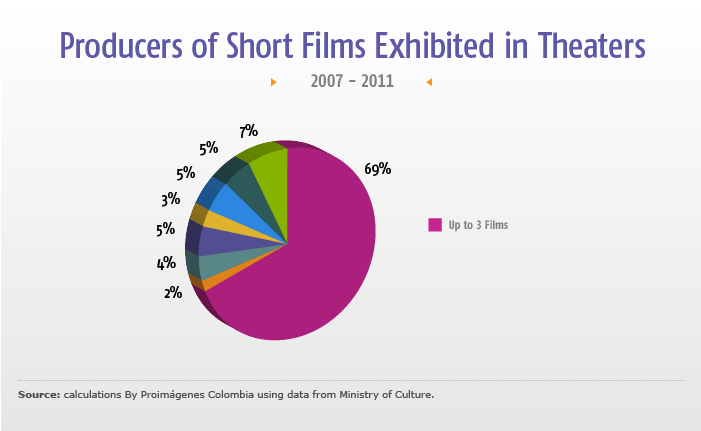
- 69% of short films exhibited in theaters were made by producers of up to three short films; the remaining 31% of these films were made by an additional seven producers.
- There is a trend towards specialization in short films designed to meet specific theater exhibition requirements.
|
